

For Nick Mason, creativity doesn't begin with a blank canvas—it begins with constraints. As a civil engineer working in the humanitarian water sector, Nick spends his days designing infrastructure in some of the world's most challenging environments. Materials change. Sites shift. Timelines are urgent. Stakeholders span languages, cultures and technical backgrounds. Yet within those limitations, Nick has found a creative process rooted in clarity, communication and iteration—and SketchUp plays a central role in bringing it all together.

Nick puts pen to paper for drawing plans.
From engineering to impact
Nick's path into engineering was driven by a simple question: How can I spend my career working on things that actually matter? That question led him to humanitarian work, where he discovered a deep passion for addressing the global water crisis—a reality that still affects more than two billion people worldwide according to UNICEF.

A lady stands under a bridge crossing a river.
Early in his career, Nick focused heavily on calculations: pipe sizing, pump selection, hydraulic modeling, etc. The goal was straightforward—move water from point A to point B. But over time, he noticed a recurring challenge:
Even the best technical designs could fall short if they weren't clearly communicated to the people responsible for building and maintaining them.
That realization marked a turning point.

A view of the river from above as Nick’s plans for the bridge commence.
Creativity through communication
"In the humanitarian sector, projects come with a lot of urgency," Nick explains. "And with urgency often comes poor communication."
Nick began using SketchUp as a way to bridge that gap—not just to design, but to communicate. For him, the creative process starts by building projects virtually, free from the physical limitations of the real world, so teams can make decisions with confidence before construction ever begins.
By modeling a project in 3D, Nick can bring clarity to complex ideas, align stakeholders around a shared vision, and focus on one small decision at a time. A typical project may involve hundreds of these decisions—and SketchUp provides a space to explore, refine and resolve them collaboratively.
"You get to build the entire construction site virtually first," he says. "Then you go out and build it once in real life."


SketchUp model of the fencing and rebar and the final image of the bridge.
Iteration as a creative practice
Nick's creative workflow is deeply iterative. Projects often begin with simple line diagrams—conceptual sketches showing how water will move through a system. From there, the models evolve as real-world constraints are introduced: local construction practices, available materials, site changes and unexpected curveballs.
SketchUp makes this flexibility possible. When plans need to change—whether it's a new site, a missing material or updated feedback from local engineers—Nick can quickly adapt the model and explore alternative solutions without losing momentum.
"We'll go from draft to 50%, 75%, 90%," he says. "Each iteration brings us closer to something that everyone understands and agrees on."
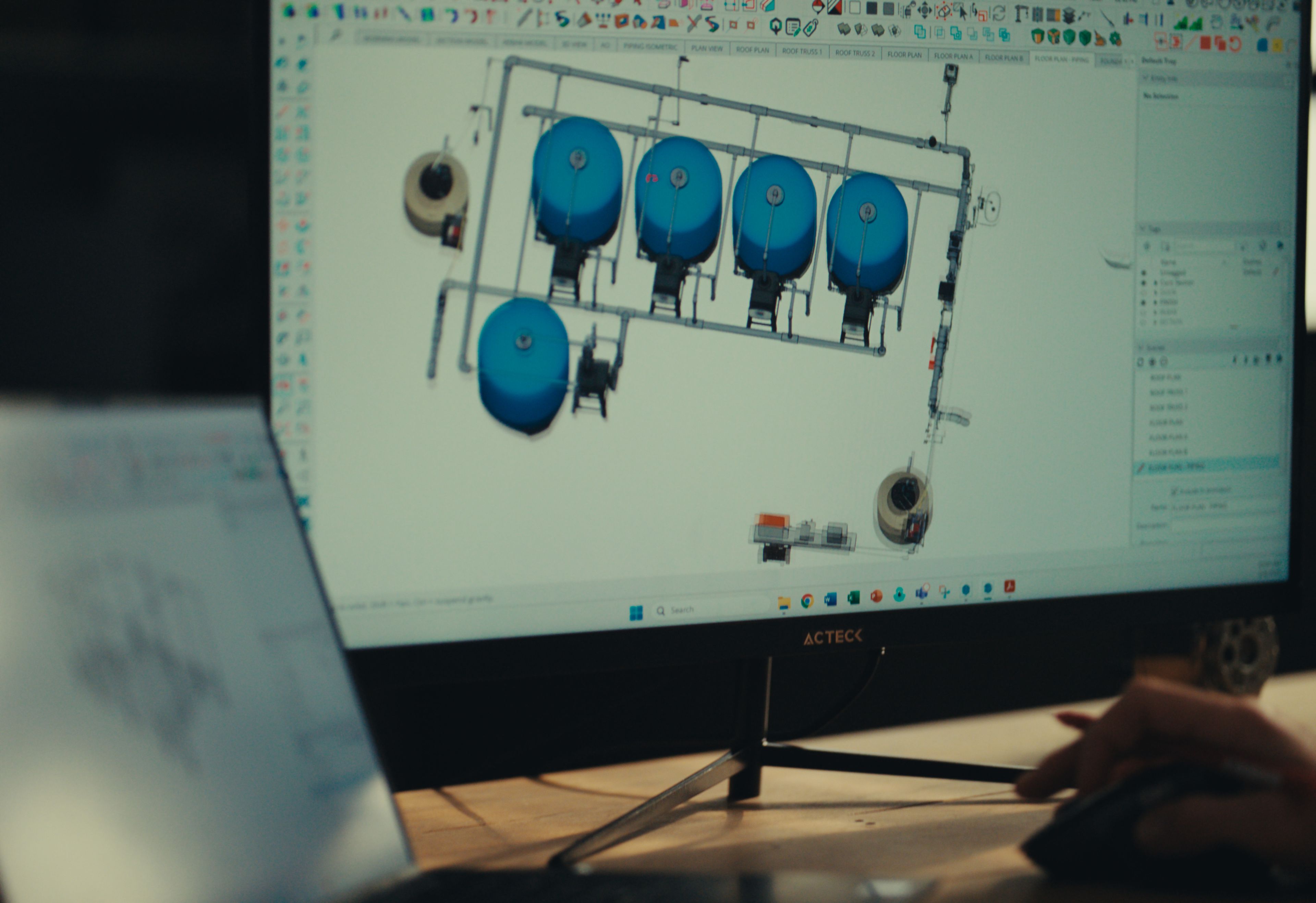
Nick works on a SketchUp model.
Organization unlocks creativity
While SketchUp supports creative exploration, it also brings structure to Nick's process. Features like tagging, grouping, components and reporting help him stay organized while scaling projects from concept to construction documentation.
Nick uses SketchUp and LayOut together to generate quantity takeoffs, integrate model data directly into drawings and produce clear documentation for contractors and local foremen. The result is a workflow that's both rigorous and freeing—structured enough to be reliable, flexible enough to invite creativity.
"In environments with a lot of limitations, being able to move into a 3D space with very few limitations is fun," Nick says.
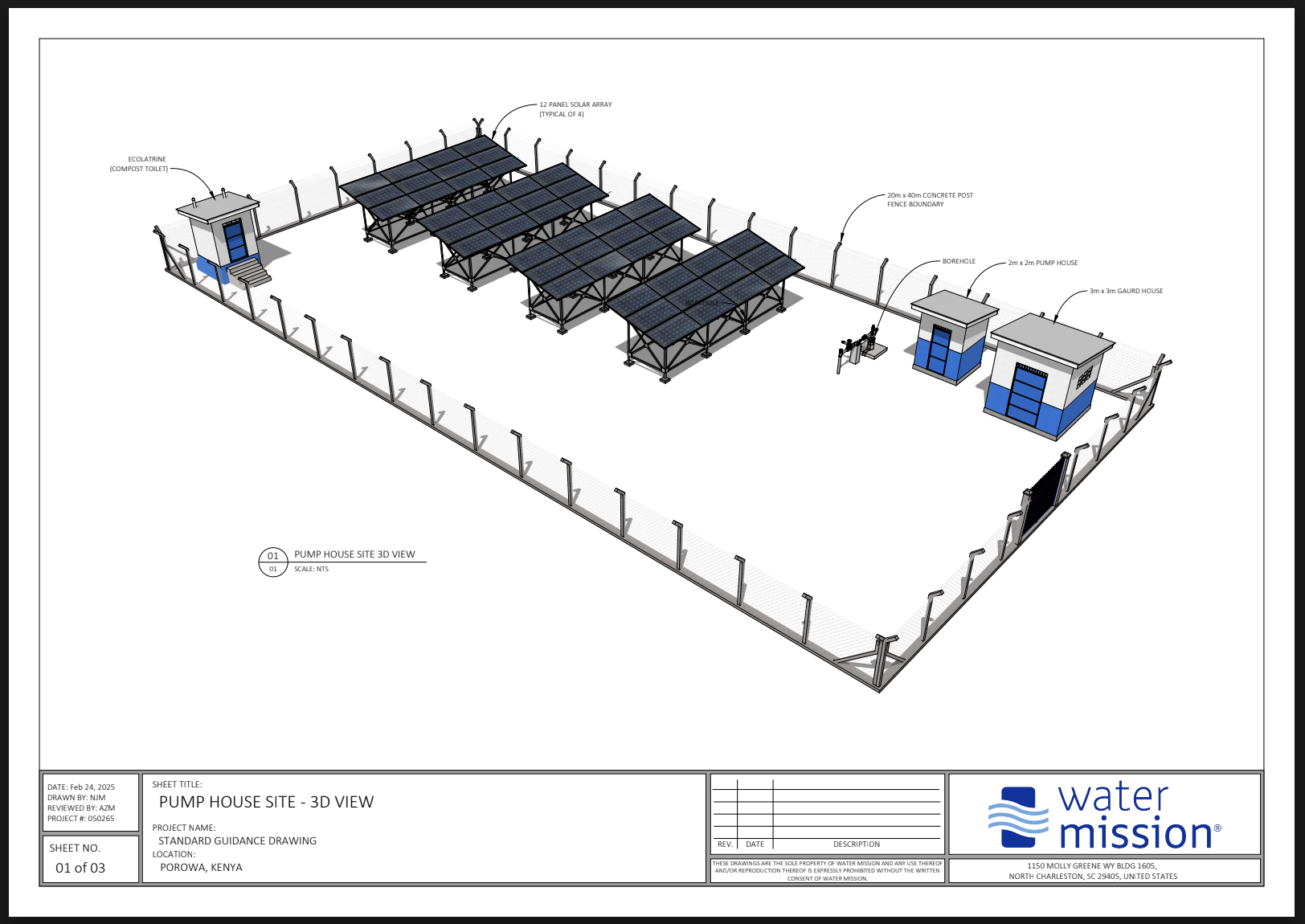
LayOut document of a pump house site for a water project in Kenya.
Storytelling that builds trust
One of the most unexpected aspects of Nick's creative process is the role storytelling plays in project success.
Many of the projects he works on are community-managed, meaning the people who help build the infrastructure will also be responsible for operating it long-term. SketchUp models and drawings become tools for shared understanding—visual stories that help everyone see the same future.
Nick recalls moments when engineers and community members gather around printed drawings, discussing each step of a project together. Those moments of alignment—when everyone shares the same mental picture—often determine whether a project truly succeeds.
"That shared visualization makes a huge difference," he says. "People get excited. They feel ownership."


SketchUp model of a solar rack in Tanzania and final image of a pump house site for a project in Uganda.
Creativity with real-world benefits
For Nick, creativity isn't abstract; it's deeply tangible. He still remembers a student project in Haiti where a SketchUp model helped plan a footbridge that later saved a life during a cholera outbreak. Experiences like that shaped his career and continue to motivate his work today.
At the end of each project, Nick often compares the final drawings to photos from the field. Seeing something that once existed only as a model now delivering clean water to a community is the ultimate validation of his process.
To hear more stories like Nick’s, check out Your Vision Realized and inspire yourself further.


