

The creative process: observation and practicality
Kailey’s creative process is rooted in observation. Her interest in photography has shaped the way she approaches design, teaching her to slow down and pay attention to the built environment and how it quietly shapes everyday experiences. This habit of looking closely informs how she understands space, material, and context before any formal design work begins.

Photograph taken by Kailey with a point of view of looking up at a building.
When she moves into design, her approach is intentionally pragmatic. Ideas start on trace paper with loose, instinctive sketches—what she calls “chicken scratch.” She explores as many variations as possible, allowing the work to evolve through repetition until a direction begins to feel right. Throughout this phase, she remains deeply focused on the details, constantly asking why things work the way they do and ensuring that every idea can realistically be built.
There is often a distinct turning point in the process, when the design starts to come together through material choices. Selecting palettes helps translate abstract concepts into something tangible, grounding the project in reality and giving it architectural weight.
Kailey also draws inspiration from the work of others, especially within Chicago. She cites architect Jeanne Gang as a major influence, admiring her use of natural forms and the way her buildings reflect the tones, movement, and fluidity of the ocean.

Kailey writes at her workspace.
SketchUp: the tool for speed and ideas
SketchUp is an essential part of Kailey's early and iterative workflow, valued for its speed and simplicity:
Quick iteration: She describes using SketchUp as like sketching on paper, which allows her to quickly translate sudden ideas into models. This ability to be quick is vital for rapid iteration.
Workflow: Kailey often creates multiple models of a design—sometimes five different versions—which she exports and revisits, pulling the best parts from each to create the final, "perfect one".
Test fitting and zoning: SketchUp is used very early on in the test fitting portion of a project to confirm whether the building meets performance requirements, including areas, heights, and zoning.
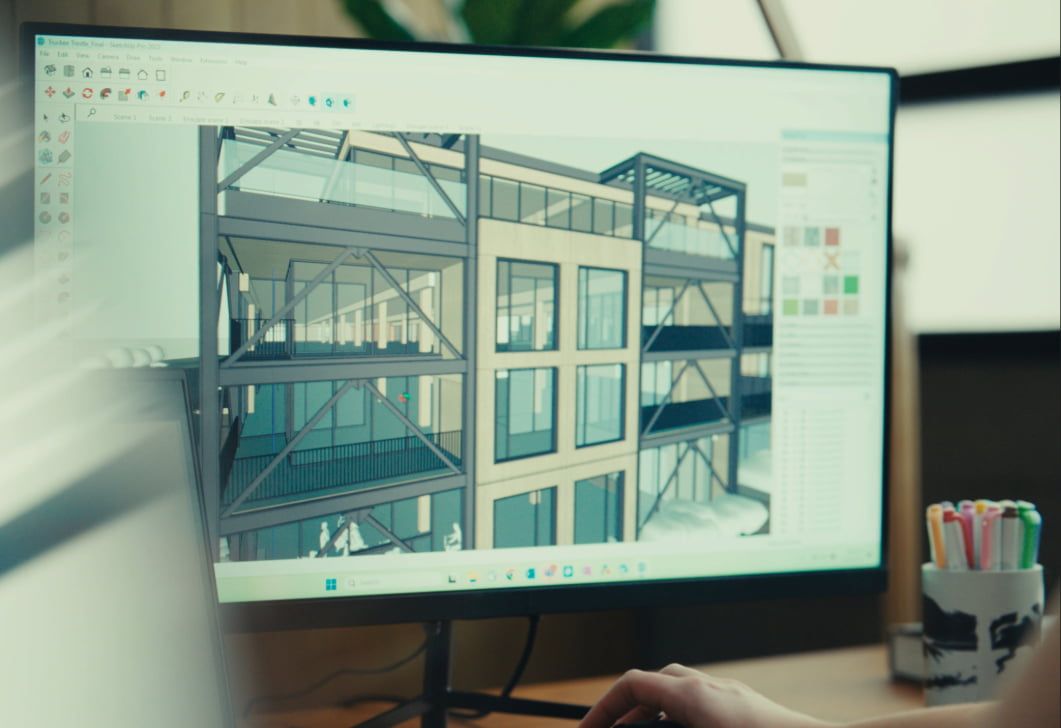
SketchUp model of a building.
Collaboration and mentorship: fueling the future
Kailey’s commitment to collaboration extends naturally into mentorship, where she sees shared learning as essential to shaping the future of the profession. For nearly seven years, she has mentored high school students in Chicago through the ACE Mentor Program, working closely with around 30 students as they move through an intensive 17-week project. The experience reflects her belief that access, guidance, and encouragement can open doors early on.
A key focus of the program is setting students up for long-term success. Kailey helps introduce practical tools like sketching techniques and accessible 3D modeling software such as SketchUp, giving students an early foundation in design thinking. By learning these skills before college, students are able to build confidence, develop fluency, and gain a meaningful head start in their education.
The mentorship is not one-sided. Kailey draws constant inspiration from the students themselves—their bold ideas, unfiltered creativity, and lack of preconceived limits. Their curiosity serves as a reminder to stay open and imaginative, reinforcing the value of mentorship as a truly mutual exchange.

Kailey flips through a book sourcing inspiration.
A dedication to timber and sustainability
Kailey primarily works on heavy timber mass timber office buildings across the US. Her studio champions this material for several reasons:
Sustainability: Heavy timber has a lower carbon footprint compared to steel and concrete, making it a more sustainable option for the built environment.
Biophilia: It appeals to the human desire to be in a more natural environment, which enhances the workplace experience.
Efficiency: Using heavy timber, such as glulam or cross-laminated timber (CLT), allows for the prefabrication of components, leading to faster construction.
Kailey's journey—from knowing her calling at age seven, to using SketchUp for her first big intern task, to becoming an eight-year veteran architect—reflects the deeply personal and creative influence that one project has on the next.
"It's a career built on observation, iteration, and a commitment to inspiring the next generation of designers."
Kailey Smith, Architect
To hear more stories like Kailey's, check out Your Vision Realized and inspire yourself further.


