

Sound and vision: a calling and a career
Sayoko Osada’s journey into directing and production design was spurred by a deliberate choice: to use space as a language to communicate a multisensory experience. This interest in spaces led her to study architecture. At the same time, she was playing in an orchestra. As a career path, architecture steered Sayoko to the spatially expressive field of production design, but it was the remarkable fusion of sound and spatial visualization that refined her renowned, world-building talents.
“When I’m designing, I think of space in a very musically driven way,” Sayoko says.
When Sayoko hears music, she envisions buildings. Spaces, meanwhile, are seen as musical expressions. For her, synesthesia influences the design process.
Blurring the boundaries between designed spaces and music is a big part of Sayoko’s creative spark. She also carries a perspective deepened by her heritage. Originally from Japan, she absorbed Japan’s cultural emphasis on non-verbal communication and human-centric designs. By anchoring her creativity to these principles and using SketchUp for the design process, Sayoko transforms environments into immersive narratives.
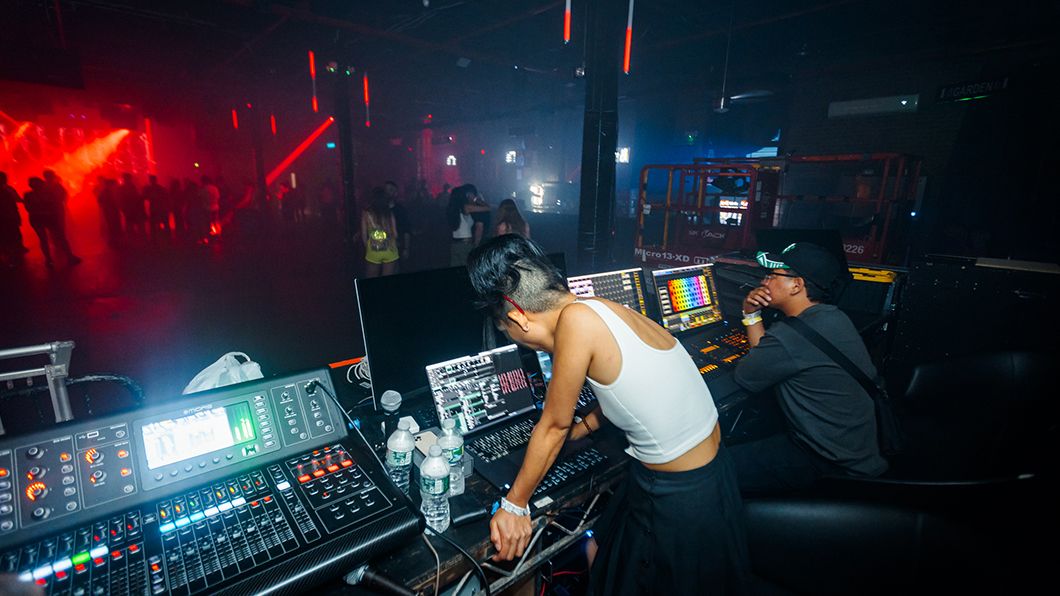
Sayoka adjusts the ambiance to set the environment at a concert.
Collaboration and visualization
Each project begins with a collaborative discovery. For Sayoko, storytelling is about carefully observing existing elements. Whether she is working with a global brand or a musical artist, she starts by identifying the emotional essence with her teammates.
Together, the team discusses how the client’s work makes them feel, as well as color cues and movements they see or imagine. Mood boards are a visual aid. When they go into production, SketchUp enables them to actualize their imagination in a virtual environment.
The design process of intuition and iteration
By modeling a project in 3D, Sayoko provides immediate visual clarity for a concept, ensuring her team and the artist or brand align on a shared foundation. Instead of trying to pitch a rigid, final idea, she uses SketchUp’s digital environment to test hypotheses.
"Instead of switching directions over time, I stick to a good instinctual grounding and refine it," Sayoko says. "SketchUp allows a view between a hand drawing and a perfect render, which lets us feel free to keep working on it."
Projects often begin with a raw massing layout or basic bone shapes to establish the core blueprint of the world, determining the scene and setting. From there, the models evolve as she homes in on finer details, such as textures, props and how a character flows through the environment. SketchUp enables this fluid flexibility.
“SketchUp is just the easiest tool for me to express my ideas and the dimensions,” Sayoko observes. “Even the interface default makes it look like I’m just drawing with pencils. I do a lot of just using SketchUp to produce different versions, line them up next to each other so I can walk in different versions and see how it looks.”
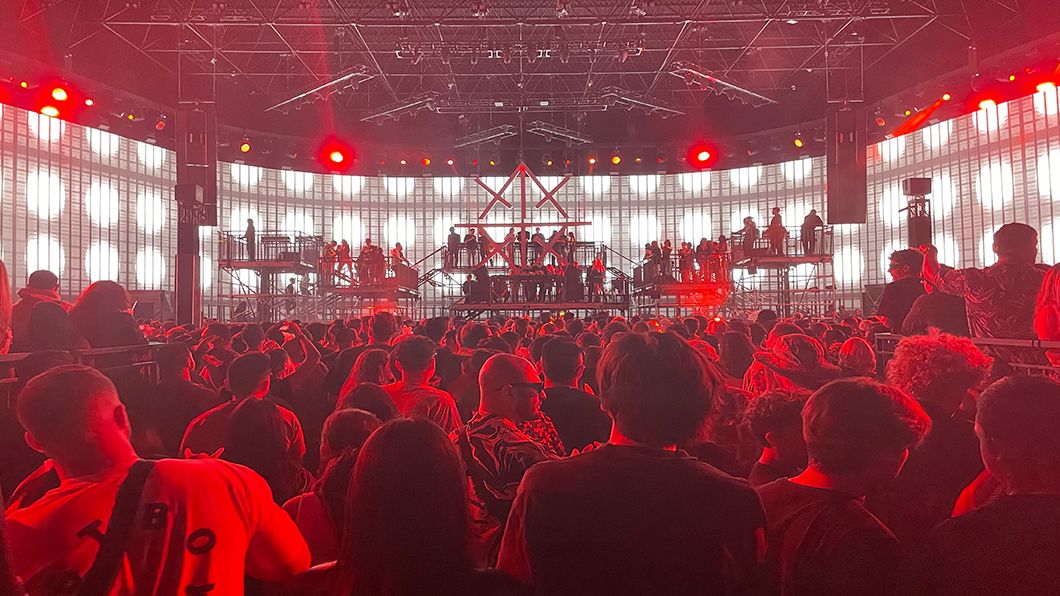
Concertgoers are part of a show’s multi-sensory experience.
From virtual to built: a dynamic workflow
To maintain an uninterrupted creative flow state across her unpredictable working hours, Sayoko leverages SketchUp’s embedded digital capabilities and AI tools for the design process. She highlights her top three:
AI material integration for stitching together seamless textures directly inside the model.
AI visualization tools for exploring early conceptual directions. Sayoko can draw basic geometries, write a descriptive prompt and instantly generate fully rendered lighting and scenery options to jumpstart a session.
Real-time desktop collaboration for walking stakeholders through the environment and making live adjustments to components.
Sayoko elaborates, “SketchUp is really like a live workshop tool for me and I love it because we often work with team members across the world. Even on the desktop, you feel like we’re in the environment together. It’s a really good tool visually and spatially to collaborate and iterate, live.”
Focusing on creative direction rather than producing flat 2D construction drawings, Sayoko’s SketchUp files provide precision data for fabrication shops to build the physical sets. Instead of waiting for a static file exchange, technicians use the digital model as a dynamic source of truth, tweaking dimensions and validating materials live within the workspace to streamline the physical build.
The geography of creativity
Flowing from intuitive inspiration to physical environments extends beyond individual projects. Sayoko alters her geographic surroundings to align with the thematic goals of her work — living in New York City’s Soho neighborhood to absorb retail space design, moving to the California wilderness to experience sublime landscapes and settling in Brooklyn’s Bushwick neighborhood to collaborate closely with musical artists. Ultimately, this boundary-blurring approach transforms the rhythms of sound and culture into physical, multisensory spaces designed for human connection.
To hear more stories like Sayoko's, check out Your Vision Realized and inspire your own creative process.


